Oil palm census from drone orthomosaics
Counts every palm from a drone survey, measures crowns and spacing, and turns gaps and weak palms into a located work list for replanting and agronomy checks.
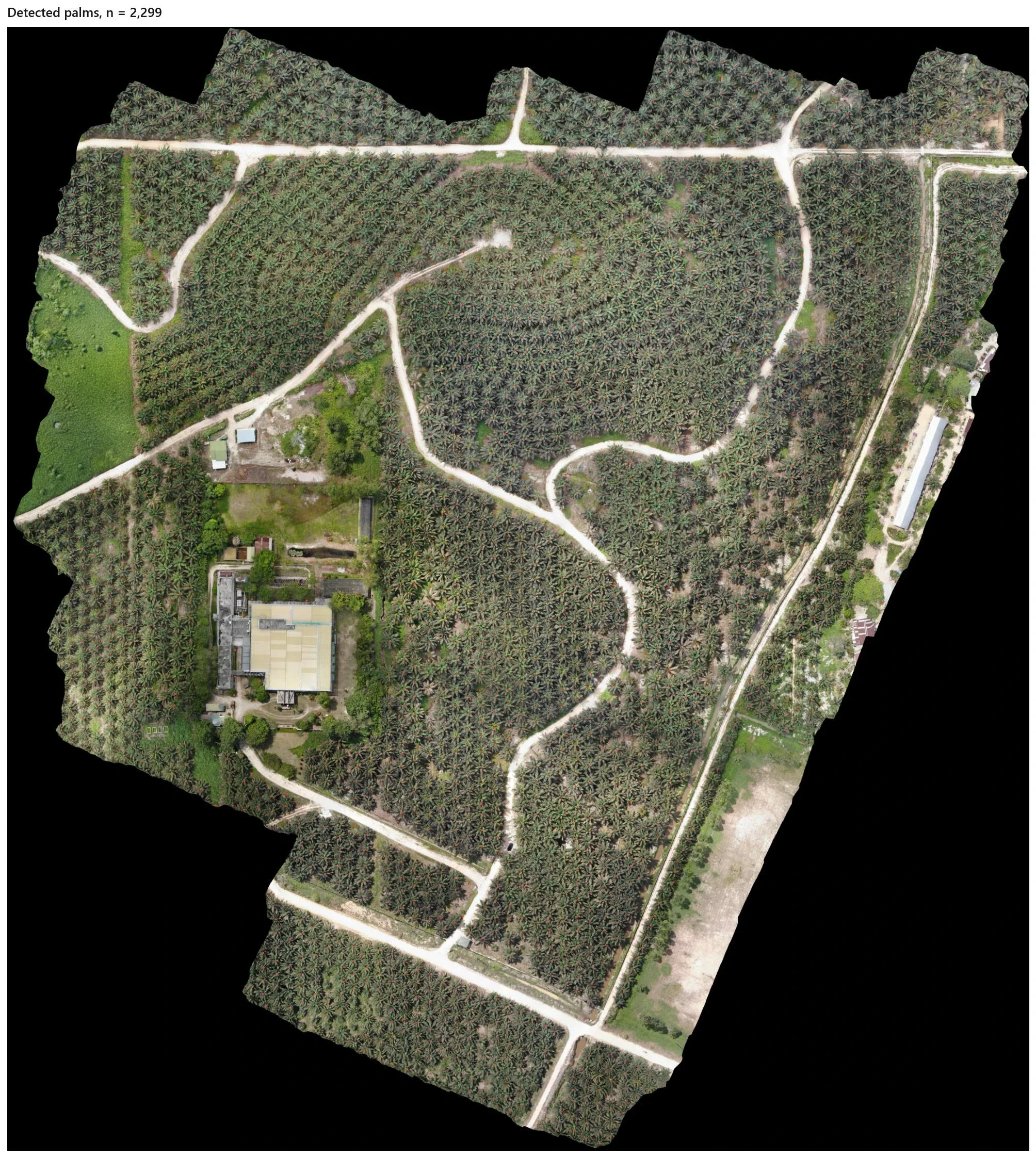
- 0.916F1 at point level on 5 hand-labelled tiles (295 palms), which also set the threshold
- -4.8% to +6.8%Count error across nearby thresholds 0.56 to 0.63, the honest uncertainty band
- 2,299Palms detected on 20.05 ha planted
- 61Gap candidates inside the planted zone, each with coordinates for a field check and infill
Problem
Plantation managers need to know how many palms are standing, where the gaps are and which palms are falling behind, because those numbers drive yield forecasts, seedling orders and fertiliser rounds. Walking a block to count is slow and error prone. A drone survey takes an hour, but only if the count that comes out of it can be trusted and the result arrives as something a field team can act on.
Approach
The 3 cm orthomosaic is resampled to 12 cm. A difference of Gaussians detector on excess green finds candidate points without any training, and those seed the first labels. Tiles are sampled evenly across clusters, pre-annotated, corrected in QGIS and used to train an RT-DETR-L detector with full rotation augmentation. Inference slides across the whole map with a distance based global suppression.
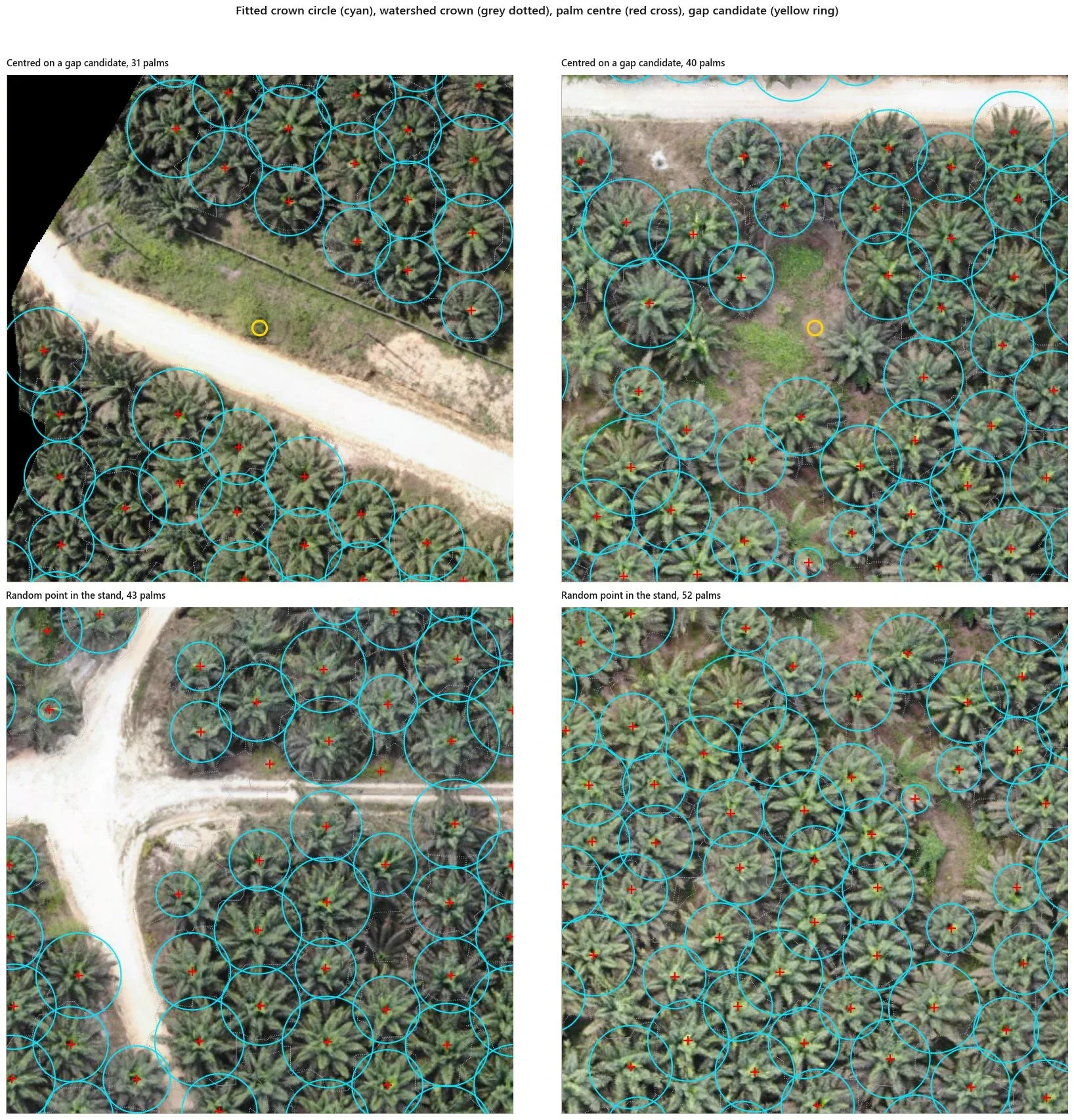
Crowns are delineated by marker controlled watershed with a 36 ray radial profile. Voronoi cells, a fitted planting lattice and Delaunay links give density, spacing and gaps.
Results
On five hand-labelled tiles the model did not train on, point-level precision is 0.910 and recall 0.922 (F1 0.916). Those tiles also set the confidence threshold, so across the neighbouring thresholds the count error ranges from -4.8% to +6.8%. That range, not the near-zero error at the chosen threshold, is the fair statement of counting uncertainty.
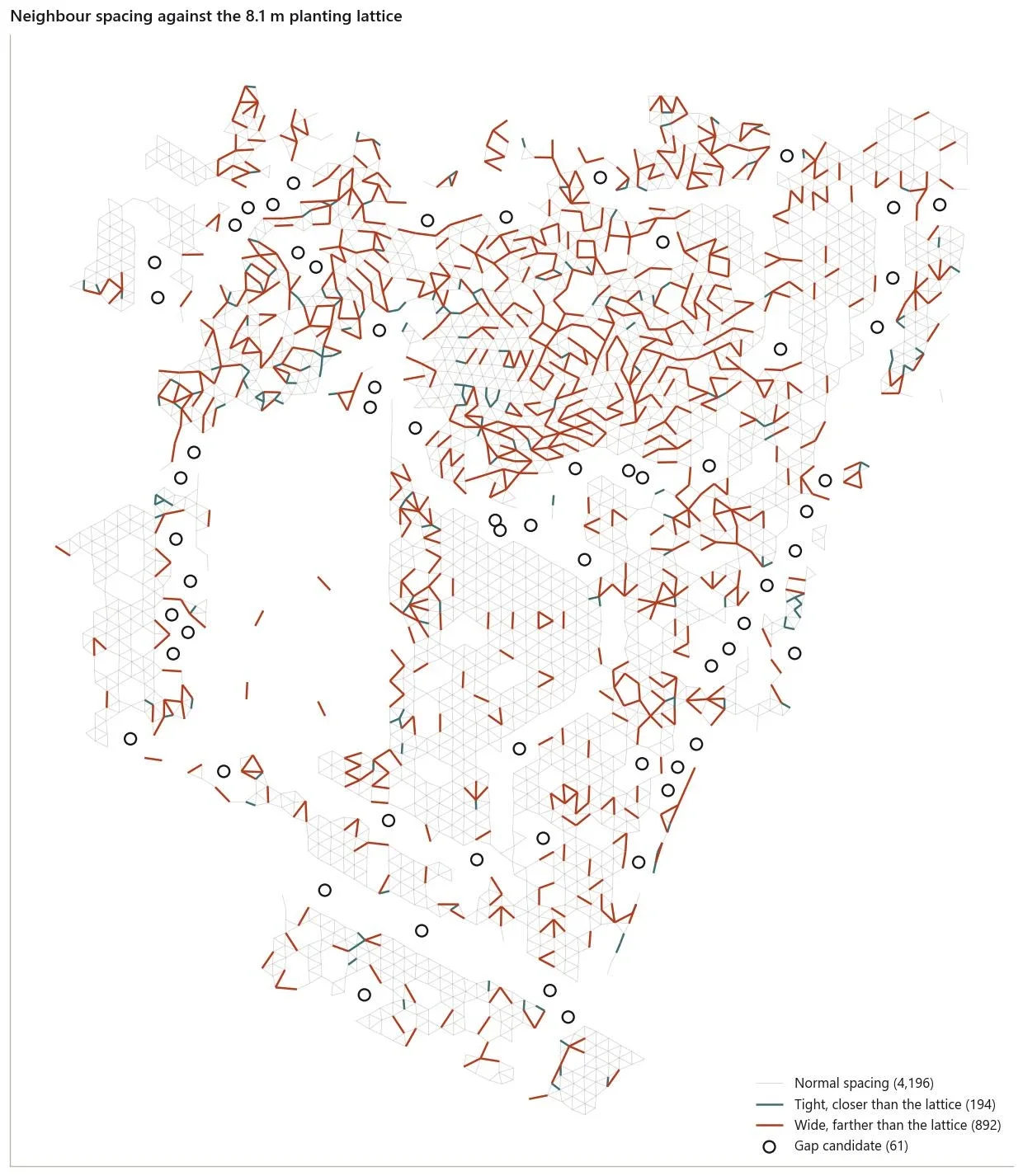
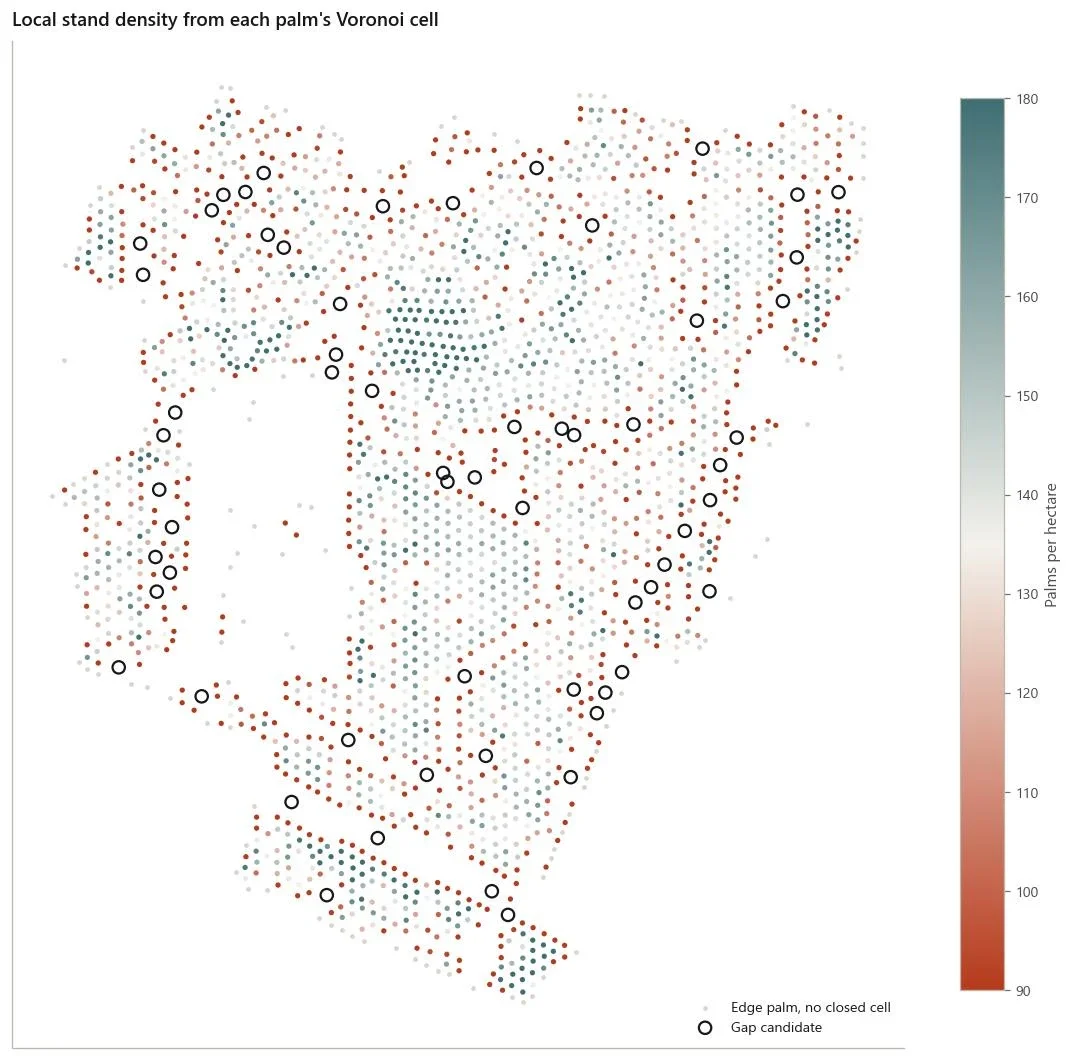
The block holds 2,299 palms on 20.05 ha of planted ground, 115 per hectare gross. The median palm has 75 m² of ground to itself, which corresponds to 132.8 palms per hectare. The planting is staggered, with 8.1 m between neighbouring palms along the dominant direction. The analysis finds 61 gap candidates inside the planted zone and flags 38 palms as stunted.
What to do with it
Every output is a point with coordinates, so the survey becomes a work list. The 61 gap candidates go to the field team as GeoPackage and CSV for a check on the ground, and the confirmed ones set the seedling order for infill. The 38 stunted palms are worth an agronomist’s visit, where nutrient status, waterlogging and basal stem rot are the usual causes to rule out. About 17% of neighbour links are wider than the planting pattern, and the spacing map shows where those cluster, which is where thinning of the stand is most likely.
The palm count itself feeds yield planning directly: standing palms times expected bunch yield per palm gives a production estimate per block that does not depend on a hand count.
The method is ready for a pilot, not for audit use. Before the count is used for an estate valuation or a certification audit, it needs an error estimate on blocks and dates that played no part in training, ideally including young palms and a peat site. A repeat survey a year later would also show which gaps were filled and which palms recovered.
The location of the block is generalised on this site.
Limitations
What these results should not be used for.
- The five validation tiles were also used to choose the architecture and the confidence threshold, so F1 is slightly optimistic and the count error is calibrated close to zero by construction. An independent estimate needs tiles or field counts that played no part in selection.
- Trained on one block, one date and one planting age. Young palms with open canopy and hazy peat sites have not been tested.
- 87 crowns, about 4 percent, could not be measured and are flagged rather than treated as small.
- Two palms closer than 5.5 m merge into one detection. In the current run 26 detected pairs sit closer than 5.8 m and 460 closer than 7 m, mostly infill and young palms, so tighter pairs would be undercounted.