Climate stress test of Indonesia's automotive export corridor
Which climate hazards threaten the estates, roads and ports that carry Indonesian vehicle exports, what a port closure would cost, and how much protection is worth paying for.
- 78.5%Share of corridor exports blocked while Tanjung Priok is closed, with Patimban at its observed throughput
- USD 624.2 MExports blocked by a 30 day closure of Tanjung Priok, of which USD 487.5 M is domestic value added
- USD 205 MPresent value of avoiding one closure day per year at Tanjung Priok, 5% discount
- USD 136 MUpper bound on the value of complete protection at Tanjung Priok, 5% discount
Problem
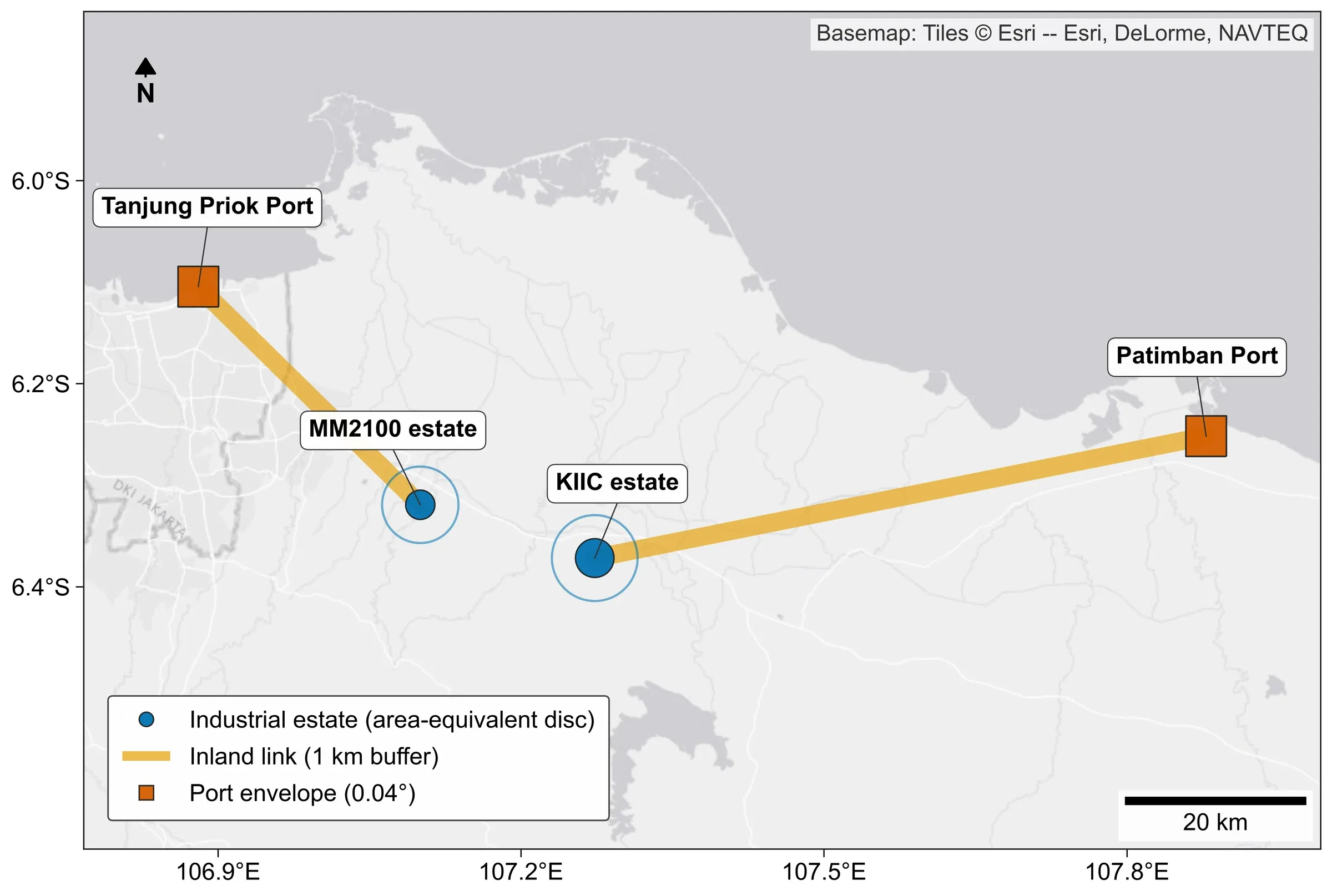
Indonesia exports vehicles and parts through a narrow corridor: industrial estates in Karawang and Bekasi, two road links, and the ports of Tanjung Priok and Patimban. Port authorities, estate operators and manufacturers have to decide how much to spend on flood defence, drainage and backup routes without knowing what a closure would actually cost. The study asks which nodes face which climate hazards, how much of the corridor’s exports a closure would block, and how much it would be worth to avoid one.
Approach
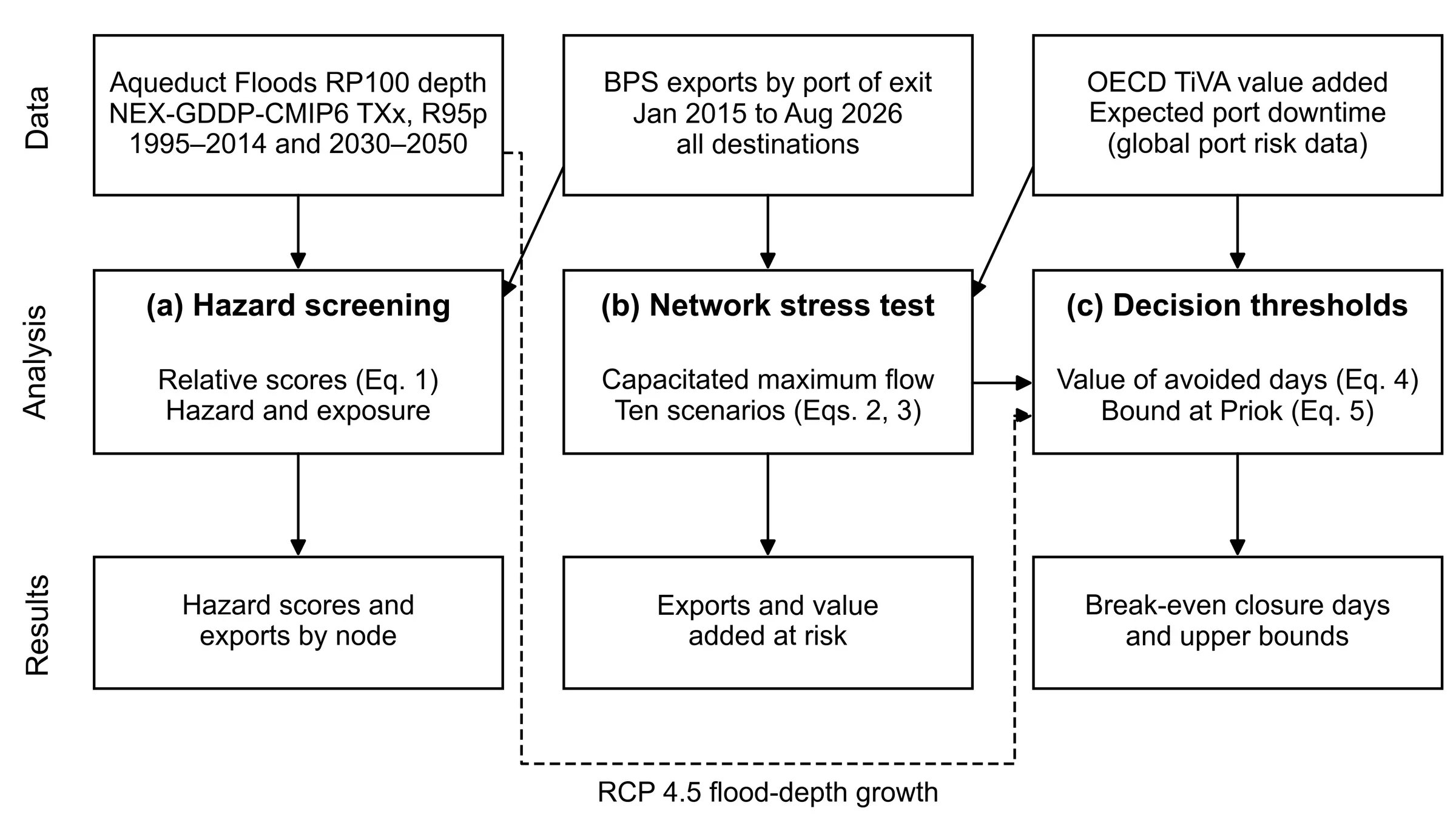
Every quantity that can be observed comes from data. Quantities that cannot be observed are reported as thresholds instead of being assumed.
The hazard screening scores each node for riverine and coastal flood depth at the 100 year return period and for two climate extremes, the hottest day of the year (TXx) and very wet days (R95p), to 2050 under two pathways: RCP 4.5 and RCP 8.5 for flood (CMIP5), and their CMIP6 counterparts SSP2-4.5 and SSP5-8.5 for heat and rainfall. Flood and heat scores are set against the exports that pass through each node and are never added into one index.
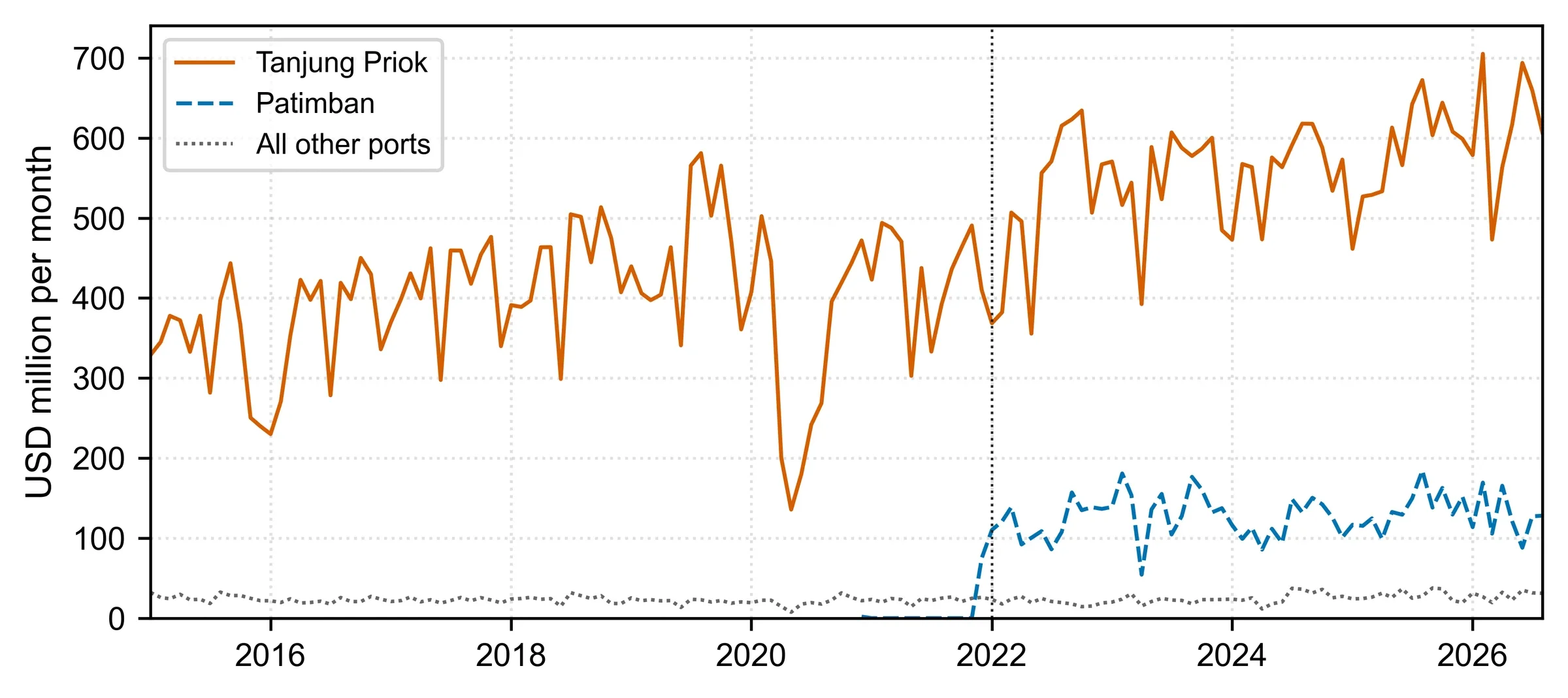
The network stress test takes capacities and routes from BPS records of vehicle and parts exports by port of exit, January 2015 to August 2026, checked against UN Comtrade: 98.7% of 834 month and destination values agree within 0.1 percent. The reference flow is USD 795.4 million per month. A port links to a destination only if it actually exported there. Blocked exports are converted to domestic value added with the OECD TiVA share of 0.781, with no further multiplier.
The decision thresholds give, for each node, the present value of avoiding one closure day every year to 2050, at 3, 5 and 8 percent discount. Tanjung Priok is the only node with a published downtime estimate, so only there is that value multiplied by expected downtime to give an upper bound on what complete protection is worth.
Results
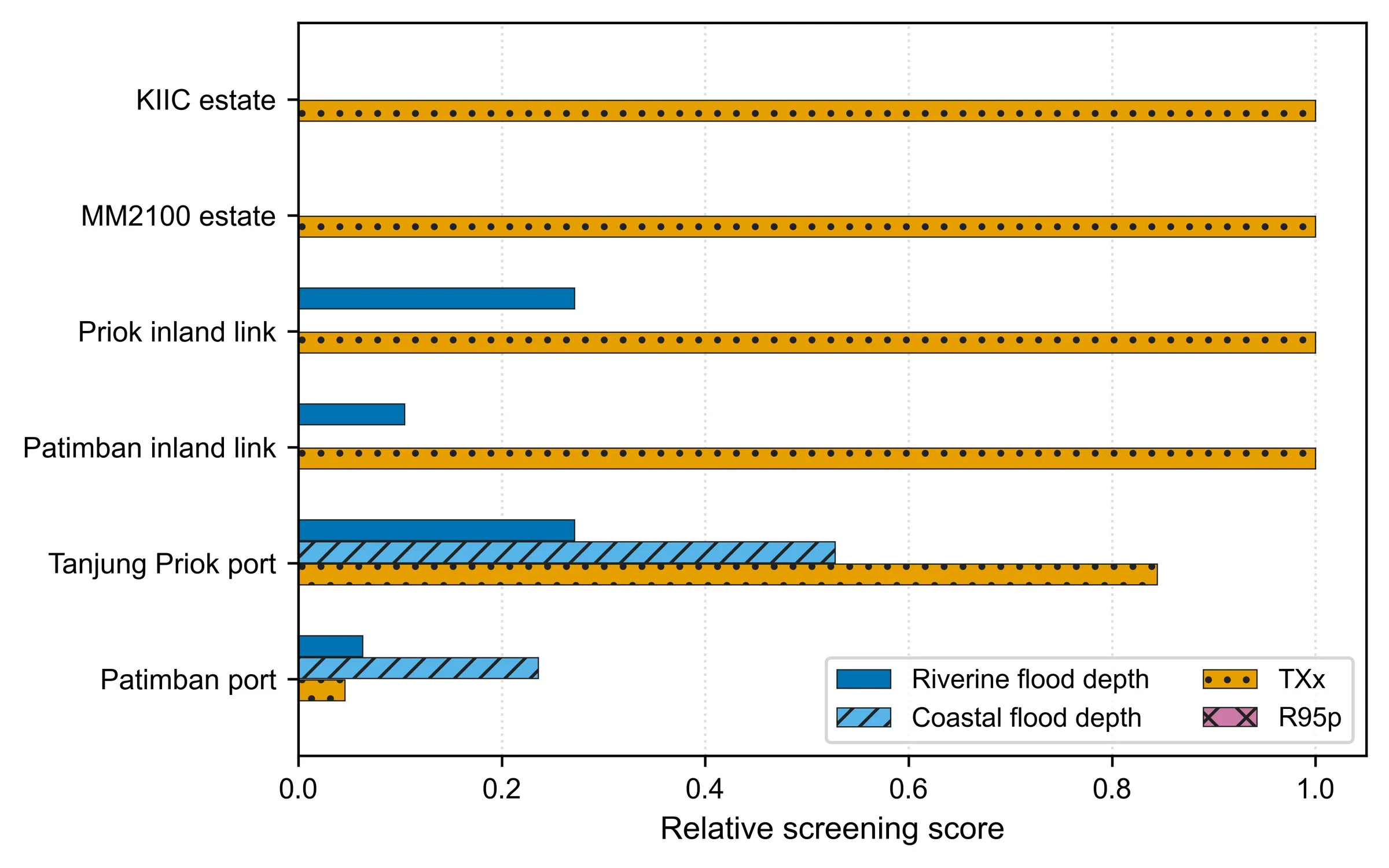
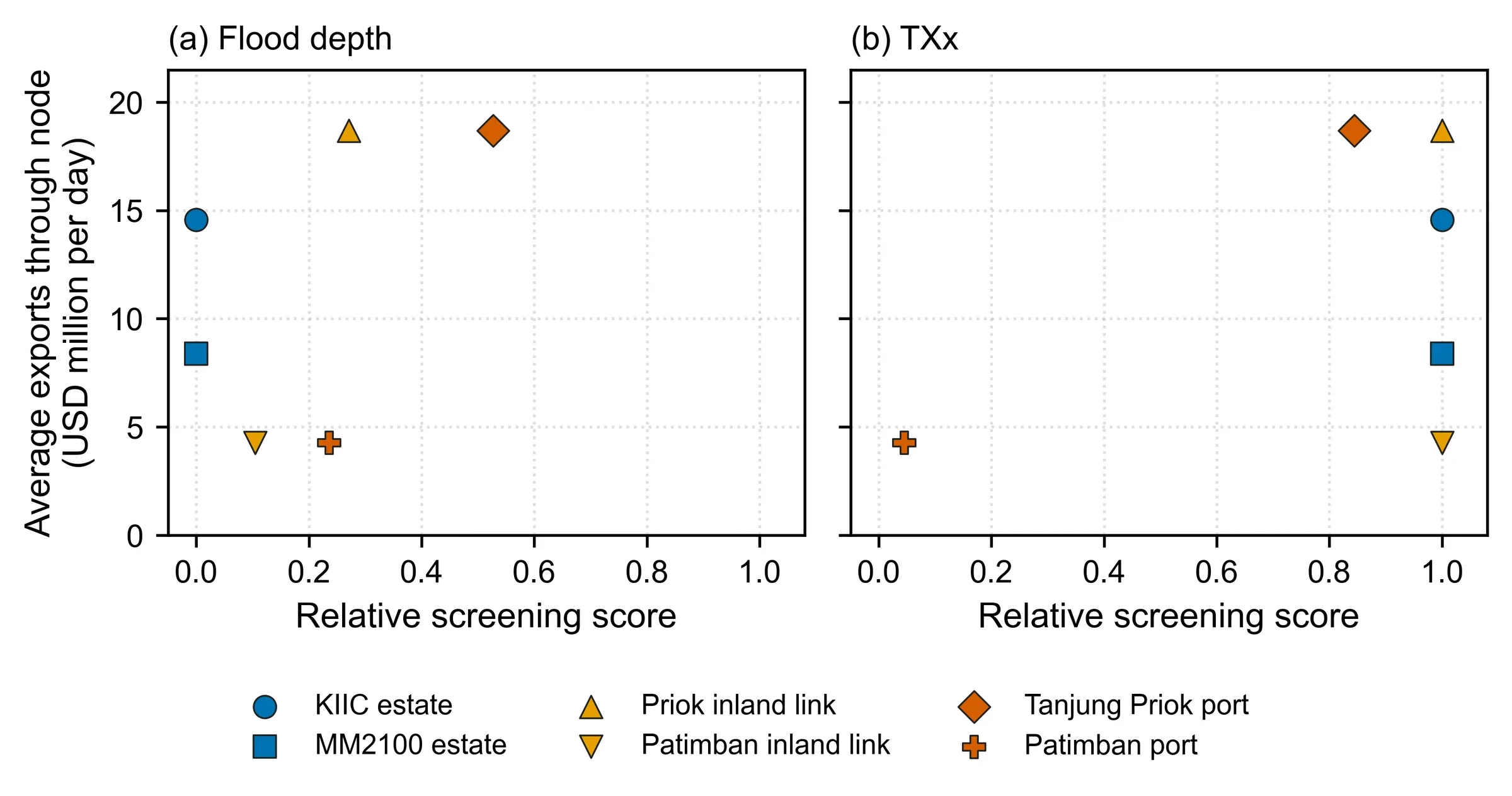
Under the high pathway (RCP 8.5 for flood, SSP5-8.5 for heat and rainfall) at 2050, the heat score reaches the top of its scale at both estates and both road links, and 0.84 at Tanjung Priok. Coastal flooding scores 0.53 at Tanjung Priok against 0.24 at Patimban. Very wet days stay at the lower limit of their scale at every node.
Tanjung Priok is the corridor’s single point of failure. While it is closed, Patimban can take only its observed throughput of USD 171.2 million per month, so 78.5% of exports cannot leave. A 30 day closure blocks USD 624.2 million of exports, of which USD 487.5 million is domestic value added. Across 54 network variants the share blocked ranges from 57.0 to 79.3%.
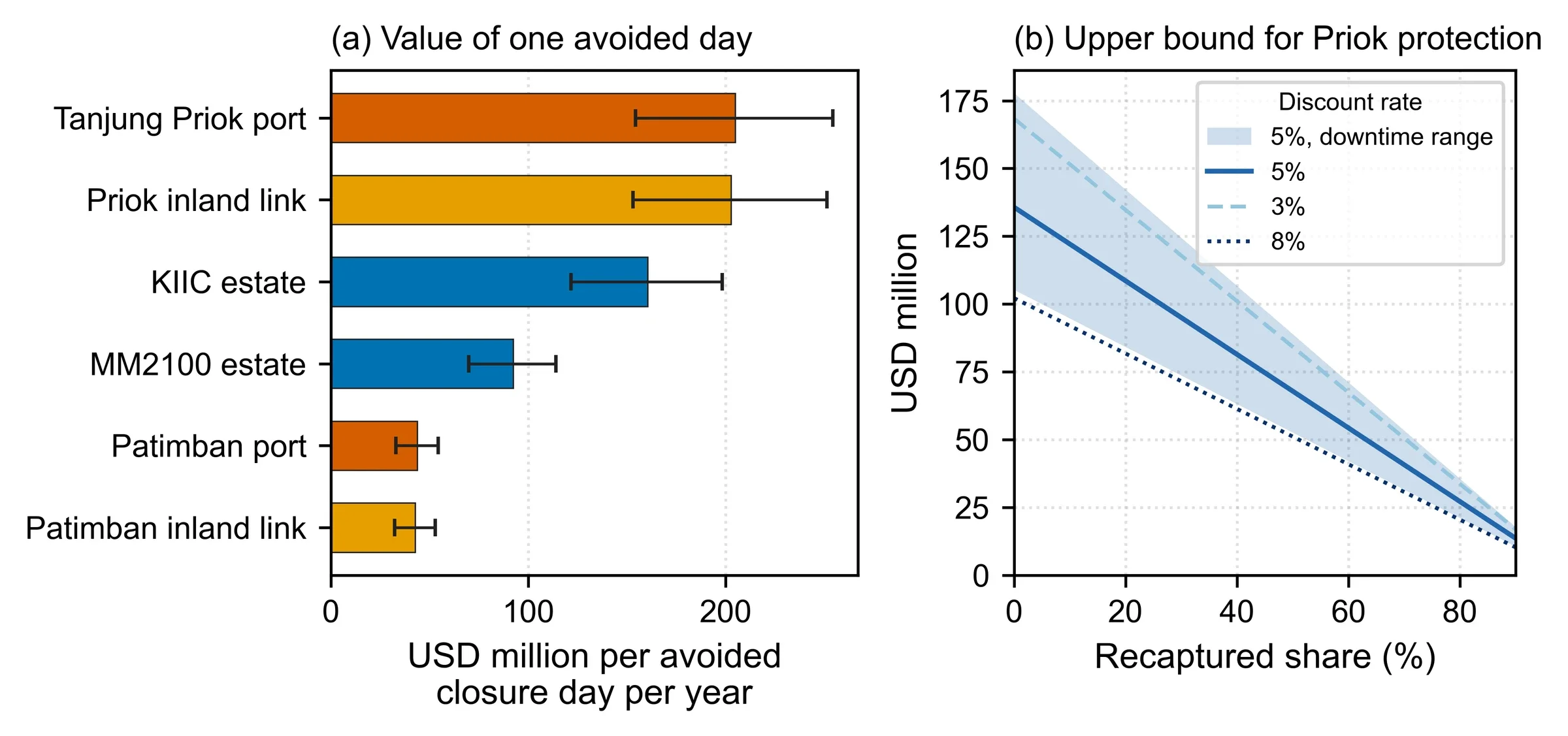
Avoiding one closure day per year at Tanjung Priok is worth USD 205 million at 5 percent (USD 154 to 254 million at 8 and 3 percent). The same day is worth USD 160 million at the larger estate, USD 92 million at the smaller one and USD 44 million at Patimban. With an expected downtime of 0.66 days per year, complete protection of Tanjung Priok is worth at most USD 136 million to the corridor’s exports (USD 105 to 178 million over the downtime range).
What to do with it
Keeping Tanjung Priok’s vehicle terminals open matters more than any other measure in the corridor. A second port helps less than it seems: even with Patimban handling twice its observed throughput, 63% of exports would still be blocked during a Priok closure. Coastal flood defence, drainage and backup power at the Priok terminals, plus a written contingency plan for diverting what Patimban can take, are the first things to fund.
The thresholds turn that into a budget test. Through the corridor’s exports alone, a protection package for Tanjung Priok can pay for itself only if its present cost, construction and upkeep together, stays below USD 136 million at 5 percent, the value of preventing every expected closure. The per-day value, USD 205 million, is higher because the global model expects Priok to lose less than one day a year; it is the yardstick if local records show more downtime than that. Engineering cost estimates can be checked against these numbers directly, without assuming a benefit cost ratio.
Heat is the hazard that reaches every estate and road by 2050. This study does not cost it, but it argues for heat stress rules in shift planning and for cooling in loading areas before it becomes a production problem. Rainfall extremes show no measurable effect on monthly exports, so they do not justify spending on their own on this evidence.
Two numbers would sharpen every value above: how much blocked cargo is shipped later rather than lost, and how often Patimban, the estates and the road links actually close. Both can be collected from operators.
Reproducibility
Every number, table and figure is regenerated by one command, and every number on this page is read from the repository’s own output tables. A parameter register records whether each input comes from data, the literature, a convention or an assumption, and which earlier assumptions the data replaced. The BPS portal does not serve scripted requests, so the records were retrieved in a browser session and every stored file is checked against a checksum before use.
Limitations
What these results should not be used for.
- Decision values are thresholds, not benefit cost ratios. They state the most a measure could cost and still break even, to be compared with engineering estimates; no construction cost or effectiveness is assumed.
- An estimate of expected downtime exists only for Tanjung Priok, from a global model. None exists for Patimban, the estates or the road links, so their values are given per avoided day only.
- The share of blocked exports that is shipped later is unknown. Every decision value scales with one minus that share.
- Estates, port envelopes and road links are geometric proxies, not surveyed boundaries or alignments. The two estates stand in for all production shipped through the corridor and split it by area, a choice tested in the sensitivity grid.
- Flood uses one CMIP5 model and the climate extremes a five model CMIP6 mean; ensemble spread and dependence between hazards are not quantified. The flood baseline and projections use different forcing, so a baseline to future difference is not a climate signal.
- The supporting regression detects no effect of rainfall exposure on monthly exports. Its confidence interval is wide, so this is a null result, not evidence of no effect.
- Recent months of BPS export data may still be revised. The manuscript has not been peer reviewed.